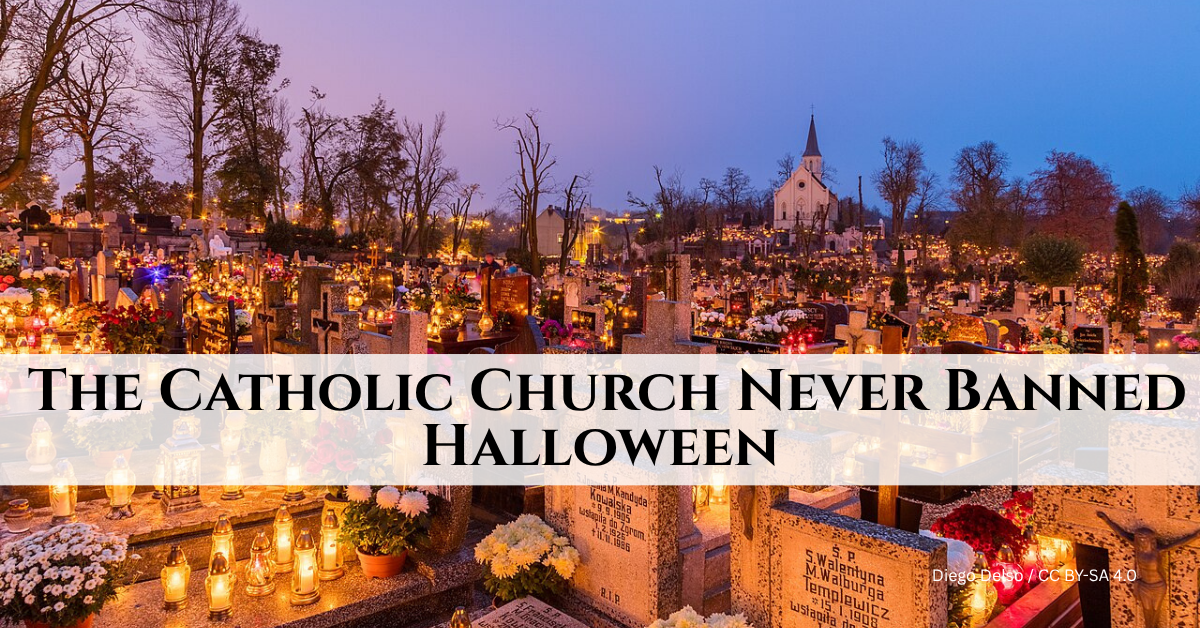
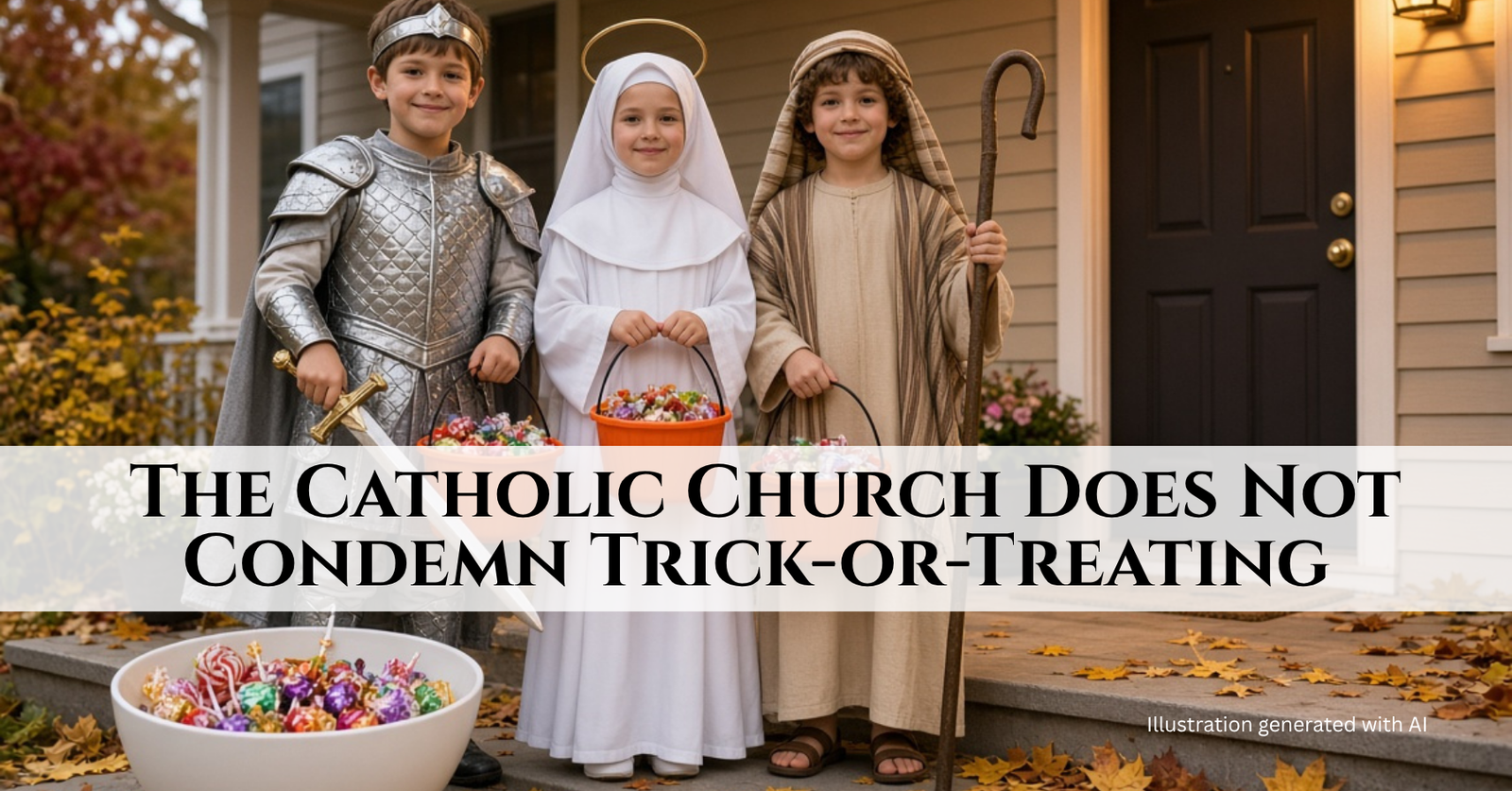
The Catholic Church does not condemn children who go from house to house collecting sweets on 31 October, even when the houses display ordinary secular Halloween decorations. Dressing as a saint and simply receiving candy is not, in itself, participation in the occult. The moral quality of the act depends on the object, the intention and the circumstances.
The Catechism of the Catholic Church states that the morality of human acts depends on three sources: the object chosen, the end in view or the intention, and the circumstances (CCC 1750). An act that is neutral in its object (receiving sweets from neighbours) becomes morally good or bad according to the intention of those involved and the concrete circumstances surrounding it. Parents who send a child out dressed as a saint, with the clear purpose of keeping the evening as the vigil of All Saints, and who avoid houses or parties that promote the occult or mock the faith, are not committing a sin. The same Catechism condemns superstition, magic, sorcery and recourse to demons (CCC 2110–2117). These prohibitions apply when the evening is used to celebrate or trivialise those realities, not when a child simply walks from door to door in a saint’s costume.
Criteria parents may consider
Catholic teaching leaves room for parental judgment. The decisive criterion remains that of the Catechism: the object of the act, the intention, and the circumstances (CCC 1750).
Some parents choose to link the evening to the vigil of All Saints by a short prayer or by attending Mass when available. Others simply keep the activity limited to collecting sweets in ordinary costumes. Both approaches are compatible with the Church’s teaching, provided the occult and mockery of the faith are avoided.
Costumes that represent saints, biblical figures, or neutral characters do not, in themselves, involve participation in the occult. Costumes that depict or glamorise demons, witches, or horror are more difficult to reconcile with the Catechism’s rejection of the occult (CCC 2110–2117).
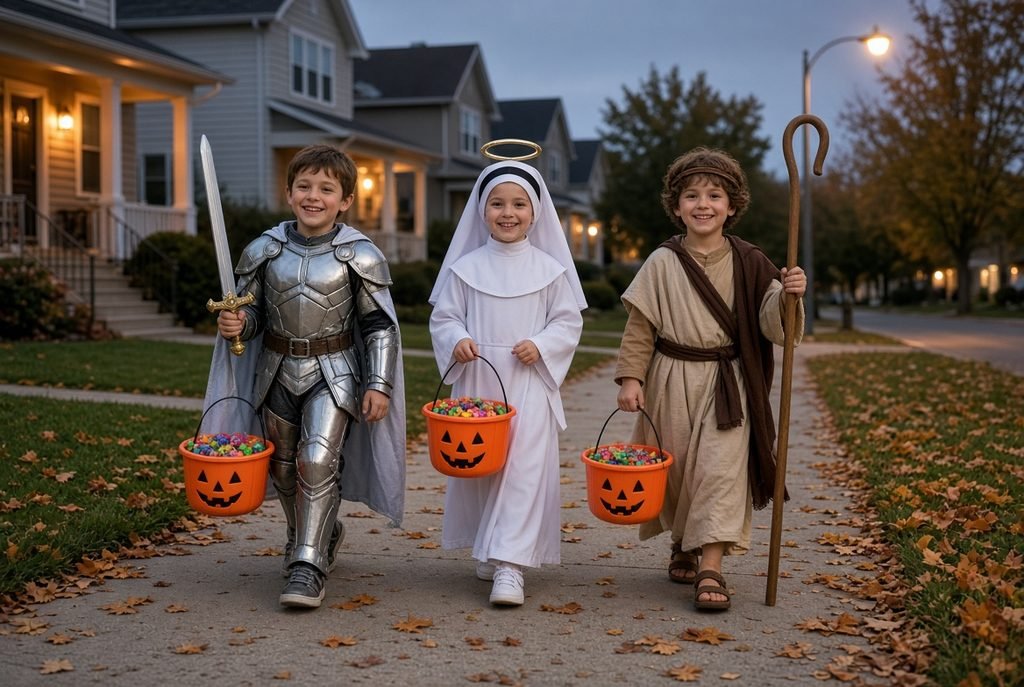
Parents remain free to decide whether the children go out or stay home. The Church has not declared either choice sinful when the criteria of object, intention, and circumstances are observed.
Jack-o’-lanterns and buckets
A plain orange pumpkin, or a pumpkin carved with a simple cross, a heart, or a neutral design, can be used as a decorative element or as a container for sweets without problem. The jack-o’-lantern itself has Irish folklore origins linked to a story of a wandering soul, but its modern use is largely commercial and decorative. When the carving is limited to a friendly face or to Christian symbols, and when it is not presented as a means of warding off spirits or of celebrating darkness, it remains a neutral object. Parents who prefer to avoid any association with the folklore may use ordinary buckets or baskets instead.
Some parents prefer to avoid houses that display heavy occult imagery, explicit demonic themes, or mockery of the faith. Parties whose main purpose is horror or the celebration of darkness are also commonly set aside. Both going out dressed as a saint and remaining at home are compatible with Catholic teaching. The decisive criterion is the one given by the Catechism: the object of the act, the intention, and the circumstances.
In Norway
The Catholic Church in Norway has not issued a public diocesan statement on Halloween or trick-or-treating. No declaration from the Bishop of Oslo is known. Any guidance given in local Masses or internal circulars is not publicly available.
In 2019 the official site Katolsk.no published a short interview with Fr. Hallvard Hole titled “Hva er egentlig halloween?” (“What is Halloween really?”). The conversation addresses the origins of the custom and whether it is acceptable for a Catholic to take part. The approach of the interview is explanatory rather than prohibitive.
For a broader discussion of Halloween and Catholic discernment, see The Church Does Not Ban Halloween — Discernment Does.
Sources
Catechism of the Catholic Church, nn. 1750, 2110–2117.
This is private commentary, not an official diocesan statement.