

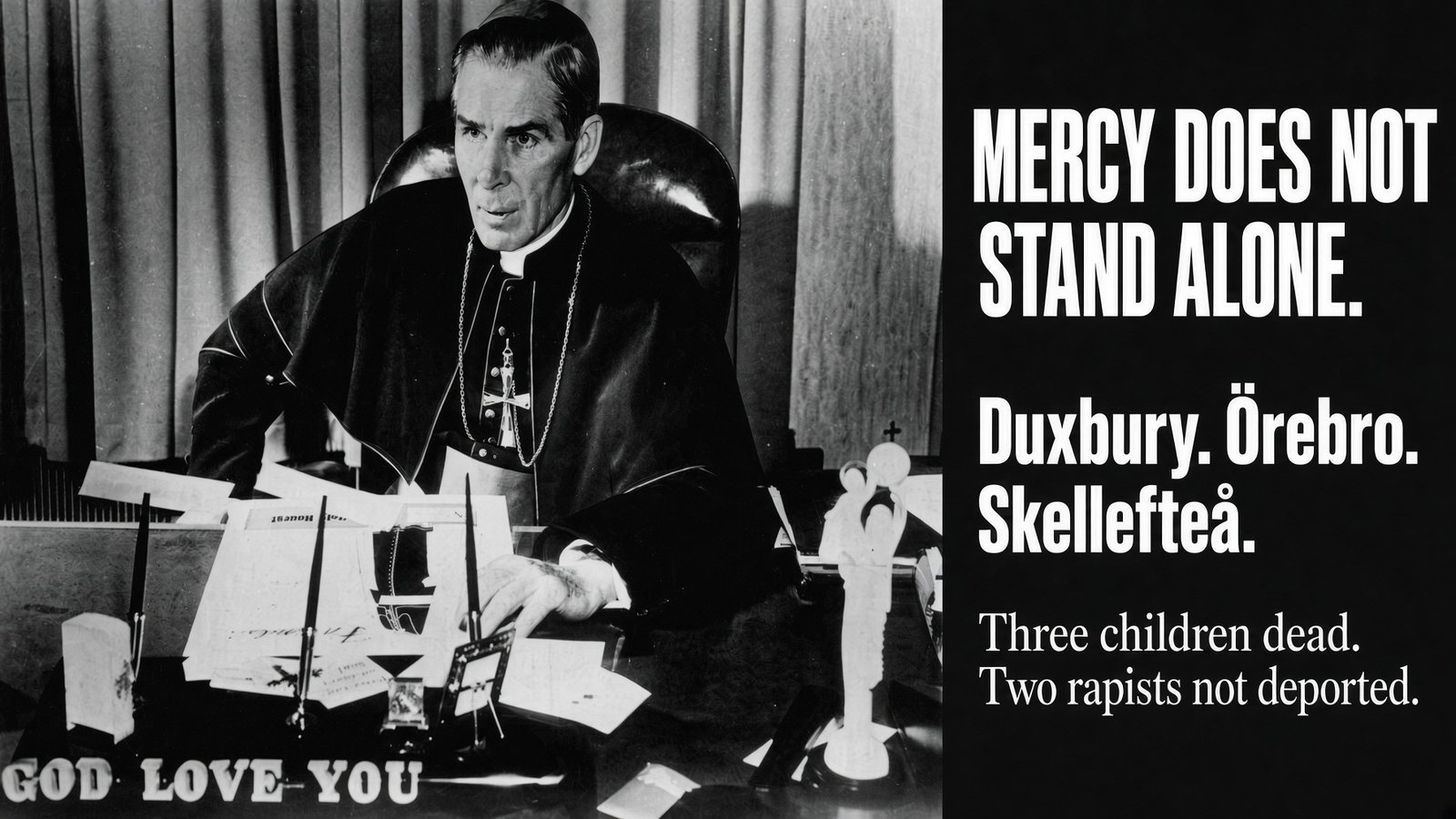
In chapter 56 of Way to Happiness, “Does Mercy Stand Alone?”, Fulton Sheen asks whether mercy can stand alone.
The answer is no.
Mercy without justice is not mercy. It is a mood. It comforts the person who feels kind and leaves the wounded person where they fell. Justice without mercy is hard. Mercy without justice is a lie. The two belong together, or neither of them is real.
Three cases show what that lie looks like now. One is American. Two are Swedish. Sweden is a small country. These rulings still traveled, because the pattern is plain: a grave crime against a child, a sentence that does not match the harm, and, in the Swedish cases, a foreign offender who is not sent home.
The book

by Archbishop Fulton J. Sheen
I have just finished reading Fulton Sheen’s Way to Happiness. It is not a treatise. It is a set of short chapters on how a Christian life is actually put together: habits, sorrow, sacrifice, the difference between a feeling and a virtue. Chapter 56 asks whether mercy can stand alone. Sheen’s answer is the old one. It cannot. Mercy that cancels justice is sentiment. Justice that cancels mercy is cruelty. God is not one and then the other. A society that keeps only the soft half has not become Christian. It has become unwilling to protect the person who was harmed.
Duxbury (the Lindsay Clancy case)
Duxbury is a town in Massachusetts. On 24 January 2023, Cora Clancy, 5, Dawson Clancy, 3, and Callan Clancy, 8 months, were strangled in their home. Their mother, Lindsay Clancy, a former nurse, has admitted the killings. She pleaded not guilty to three counts of first-degree murder. The defense says she was in postpartum psychosis and not criminally responsible. Prosecutors say the evidence allows a jury to find that she knew what she was doing.
In September 2026 a jury deadlocked. The judge declared a mistrial. On 1 October the same judge refused to throw the charges out. He wrote that the physical and circumstantial evidence could let a rational jury find the elements of murder, and that prosecution experts had testified she did not lack the capacity to appreciate the wrongfulness of the act. A hearing is set for 2 November. Prosecutors have not yet said whether they will retry her. If they do, and she is convicted of first-degree murder, the sentence is life. If a jury finds her not guilty by reason of insanity, she goes to a psychiatric hospital, subject to review.
The children are dead either way. A diagnosis explains a mind. It does not erase three small bodies. Sheen’s point applies before the next jury is seated: mercy that cancels the question of guilt is not mercy for the dead. It is an exit from the moral order. The court still has to ask whether she could tell right from wrong. That question is justice. Skipping it in the name of compassion is the thing Sheen refused to call mercy.
Örebro (a Syrian citizen got five years for raping a child, and was not deported)
Örebro is a city in central Sweden. On 23 September 2026, Örebro District Court sentenced a 37-year-old Syrian citizen to five years in prison for the rape of a child. The victim was his stepdaughter. She was under 15 when the assaults began. They ran from January 2024 to June 2026, in Örebro and in Hällefors. She told police the abuse became ordinary: vaginal, oral, and anal, so often that it felt like everyday life. The court ordered 540,000 kronor in damages.
The prosecutor asked for deportation. The Swedish Migration Agency told the court there was no obstacle to removing him. The court refused. He has lived in Sweden since a permanent residence permit in 2014. He has other children here. The judgment says his ties to Sweden are “fairly strong,” and that expulsion would hit him and those children “fairly hard.”
Read that twice. The girl who was raped by the man in the house is not the person the court was protecting from hardship. Five years, then the right to stay.

Skellefteå (an Eritrean refugee got three years for raping a 16-year-old, and was not deported)
Skellefteå is a town in northern Sweden. In September 2024 a 16-year-old girl missed her bus after a shift at McDonald’s. In a pedestrian tunnel she was grabbed and raped. The attacker was Yazied Mohamed, then 18, an Eritrean man with refugee status and permanent residence. A lower court found that the rape was proved, but not that he was the man. On 9 September 2025 the Court of Appeal for Upper Norrland convicted him and sentenced him to three years, the minimum for rape in Sweden. It ordered 240,000 kronor in damages.
It refused deportation. Refugee law, the court said, allows expulsion for an exceptionally grave crime. This rape, in the court’s view, was serious but not exceptionally grave, given its nature and its short duration. There was no weapon. There was no intercourse, in the court’s account of the act (the sexual act itself is sealed, because she was 16). One judge dissented and would have expelled him. Prime Minister Ulf Kristersson said no one should meet their rapist on the street, and that non-citizens who commit serious crimes must leave.
Three years. No removal. The length of the rape was treated as a reason to keep the man in the country.
What our anger is actually about
We are not confused about the facts. We are watching two different evasions of the same duty.
In Massachusetts, part of the public wants the word “ill” to end the Lindsay Clancy case. Illness may be real. It may limit responsibility. It does not make the killing of three children a private tragedy with no defendant. The state still owes the dead a verdict on guilt.
In Sweden, the courts are applying rules that treat residence, other children, and refugee status as reasons to outweigh the crime. In Örebro: repeated rape of a child, five years, then the right to stay. In Skellefteå: the rape of a 16-year-old, three years, then the right to stay, because the assault was not judged long enough or grave enough. The victim’s claim is finished when the damages are set. She is paid, and the case is closed on her. Nothing changes for him. He stays. The status he had before the rape is the status he has after it.
Sheen would not have called either move mercy. Mercy presupposes the truth of the wrong. It does not rewrite the wrong so that the wrongdoer is the one who must not suffer. A society that cannot face the killing of children, or that cannot remove a foreign national who rapes a child, has not become gentle. It has become unwilling to defend the weak when defense costs something.
Justice names the act. Mercy, if it comes, comes after, and it does not put the offender back in the house, or back on the street, as if the act had been a misunderstanding. Mercy does not stand alone. When a court or a culture pretends that it does, the people who pay are the ones who already paid.
What the Church actually says
Sheen did not invent the question. He put an old doctrine in a hard sentence. Mercy does not stand alone, because God is not merciful instead of just. He is both. Split them, and you no longer have either.
St. Thomas Aquinas says mercy does not set justice aside. It goes beyond what justice requires. It does not deny what justice requires. A judge who frees the guilty has not been merciful. He has been unjust to the person who was harmed. St. John Paul II says the same in Dives in Misericordia: mercy differs from justice, but it is not opposed to it. The pardoning of the wrong presupposes that the wrong is named. There is no pardon of a thing that has been redefined as illness, culture, or a short duration.
The Catechism is plain about the duty that follows. Legitimate public authority has the right and the duty to inflict punishments proportionate to the gravity of the crime (CCC 2266). Punishment is not revenge. It is redress of the disorder introduced by the offense, defense of public order, the safety of persons, and, where possible, the correction of the offender. A penalty that does not redress the disorder, and does not defend the persons who were attacked, fails that duty. Deportation of a non-citizen who has raped a child is not an extra cruelty added to the sentence. It is part of defending the people who still have to live in the country.
Charity does not change the order. The first object of charity here is the child, not the man who raped her, and not the public that wants to feel compassionate. Love of the offender is real. It is not the same thing as keeping him in the house, or in the street, or in the country. The Church has always distinguished the sinner from the sin. It has never said the sin must go unpunished so that the sinner will not be inconvenienced.
That is the Catholic reading of these three cases.
In Duxbury, postpartum psychosis may be true, and if it destroyed her capacity to know what she was doing, the law already has a verdict for that. What the Church cannot bless is the wish that the word “ill” end the case before anyone asks whether she knew. Cora, Dawson, and Callan were owed a judgment. Mercy for their mother, if it comes, comes after that judgment, not instead of it.
In Örebro and Skellefteå, the failure is simpler. The acts were judged to be crimes. The men were sentenced. Then the courts treated residence, other children, and refugee status as reasons not to remove them. Five years for the repeated rape of a stepdaughter. Three years for the rape of a 16-year-old in a tunnel, with the short duration counted in the offender’s favor. That is not the mercy of the Gospel. It is the protection of the strong against the claim of the weak. A Catholic does not have to hate the Syrian man or the Eritrean man to say they should not remain. He has to love the girls enough to say the country owes them that much.
Sheen’s chapter ends where Christian politics has to begin. Feelings are not a moral order. A society that calls itself merciful while it will not punish the killing of children, or will not expel the man who rapes a child, has not grown softer in the right direction. It has lost the nerve to tell the truth about evil. Mercy that will not stand with justice does not stand at all.
Sheen was beatified on 24 September. In Norway he was named in the Catholic press, and not in the pulpit. That is the other half of this argument. Read this: Named in Norway’s Catholic press. Not in the pulpit. https://katolskblikk.no/sheen-named-in-press-not-in-the-pulpit/