A state funeral showed what the folk church and the press had already taught the country to accept.
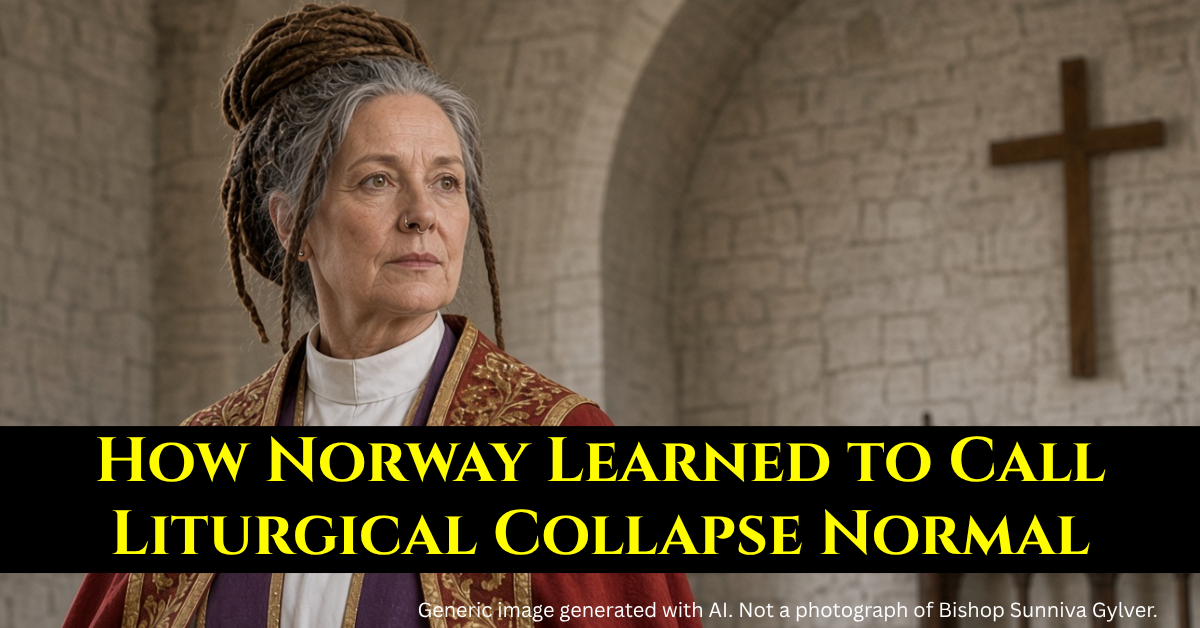
At King Harald’s state funeral in Oslo Cathedral on 9 September 2026, Bishop Sunniva Gylver stood near the coffin in dreadlocks and a nose piercing. vl.no
It was meant to be one of those rare national moments when form still matters. Procession, cathedral, liturgy, the weight of a long reign.
A royal funeral is not a youth service. It is not a festival. It is the last public act of respect a nation offers a monarch. When the person leading part of that rite looks like a statement rather than a servant of the rite, the question is not only aesthetic. It is about what a culture now considers fitting.
This is not a personal attack. Gylver has been a pastor for three decades. She lost her husband to cancer. King Harald himself attended her consecration in February 2025. The Royal House and the Church of Norway chose her. The controversy is not that she exists. It is how quickly a whole country was taught to treat her choices as the new normal — and how little the mainstream press was willing to ask whether “normal” is the same as “fitting.”
How the ground shifted
The Church of Norway is no longer a confessionally serious Lutheran church in the old sense. It is a folk church: high membership, low practice, strong cultural presence, and a leadership that has spent years aligning itself with the moral language of the secular majority — inclusion, diversity, climate, LGBTQ affirmation.
Once that alignment is complete, several things stop looking strange:
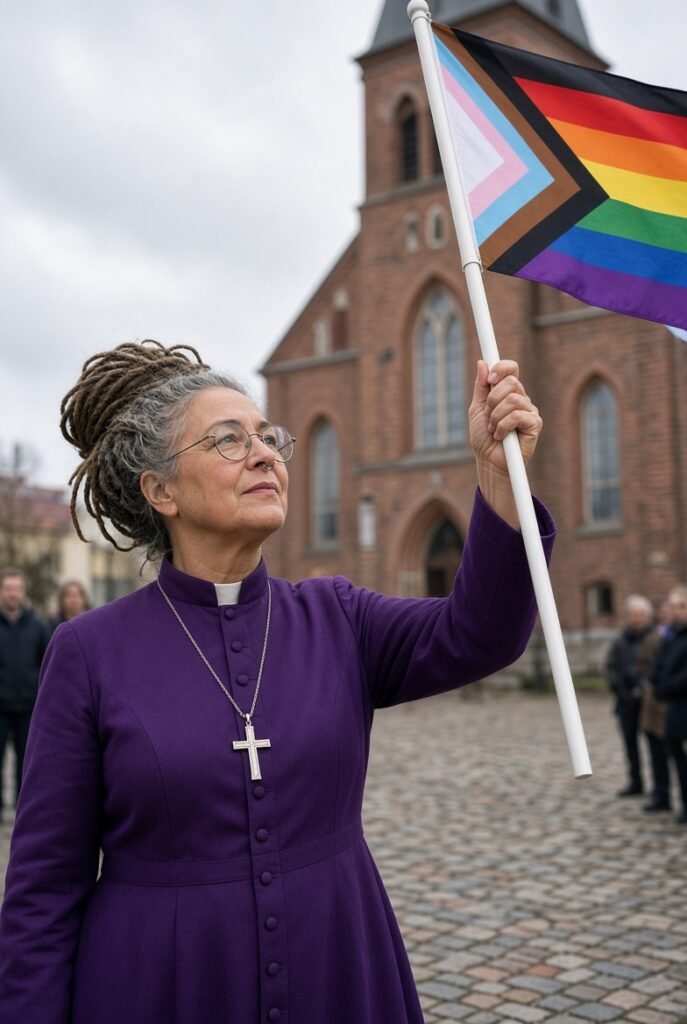
- A bishop opening Oslo Pride in front of the cathedral and raising the rainbow flag (June 2025) is reported as news, not as a theological event. nrk.no
- Yoga services inside the church — barefoot on mats before the Lord’s Prayer — are framed as “reaching people where they are.” Critics who note yoga’s Hindu roots and the risk of syncretism are often described as harsh or uncharitable.
- Informal dress and visible body modification at the highest liturgical occasions become “authenticity” and “showing the diversity that already exists in Christian communities.”
- Speculative remarks about God having a “plan B” for those who do not believe in Christ are treated as pastoral kindness rather than a departure from classical Christian teaching on salvation.
Image
Illustration: a generic image (generated with AI), not a photograph of Bishop Sunniva Gylver.
Mainstream outlets (NRK, Aftenposten, VG) rarely press these points. They describe. They quote Pride organisers. They note that she is “unconventional.” They do not ask whether a state funeral is the place for unconventionality. Conservative Christian papers such as Dagen have been more willing to raise doctrine, liturgy and syncretism. They are a minority voice.
When institutions and the dominant media repeat the same frame for years, the population follows. Norway is already one of the most secular countries in Europe. For many, church is culture, not dogma. If the bishop says this is inclusion, and the newspapers treat it as inclusion, then objecting starts to feel like bad manners.
Mainstream media treat it as normal because, in the present consensus of the country’s cultural and church elite, informal appearance plus an emphasis on inclusion is already the new standard of the Church of Norway. To criticise the bishop’s hair — or the fact that she is a woman bishop — at a state funeral is, in that milieu, coded as backward or even prejudiced. That is why direct criticism almost never appears in the largest newspapers. They do not have to argue the case anymore. They only have to describe the scene as if nothing were out of place.
What a Catholic eye sees
From a Catholic standpoint the issues are distinct and should be named without heat.
1. Holy orders and the nature of the Church.
The Catholic Church does not recognise women as bishops. That is not a slight against Gylver’s intelligence or goodwill. It is a doctrinal claim about the sacrament and apostolic succession. A Lutheran folk church that has long accepted women bishops will of course place one at a royal funeral. An international Catholic reader still has to register the difference.
2. Syncretism.
Yoga is not neutral stretching. Its classical aim is union with an impersonal divine. Placing it inside a Christian liturgy, in front of the altar, confuses what worship is. The fact that it attracts some people does not make it theologically safe. Charity toward seekers does not require borrowing another religion’s spiritual technology.
3. The meaning of a royal funeral.
A state funeral is public liturgy for the dead and for the nation. Its first duty is reverence, not representation. Visual novelty that would be at home in a parish experiment becomes something else when it stands a few steps from a king’s coffin. One can respect Gylver’s pastoral intent and still say: this was the wrong register.
4. The “plan B” problem.
Suggesting that God must have another path for those who do not believe in Christ sounds compassionate. It also weakens the unique claim of the Gospel. Classical Christianity — Catholic, Orthodox, and historic Lutheran — has never taught that the Cross is one option among others.
None of this requires mocking her hair, her piercing, or her grief. It requires refusing the idea that every liturgical and doctrinal boundary is just “old prejudice.”
Why Norwegians were led to see it as normal
Three mechanisms did most of the work:
- Institutional capture. The Church of Norway’s leadership, training institutions and public voice moved first. Bishops and church communications already spoke the language of diversity before Gylver became bishop of Oslo.
- Media consensus. When the largest newsrooms treat criticism as tasteless, most citizens never hear a serious counter-argument. They hear only “inclusion versus intolerance.”
- Low religious literacy. A population that rarely goes to church has little instinct for why vesture, posture, and doctrinal precision used to matter. What remains is sentiment: be kind, be open, don’t judge.
The result is not a conspiracy. It is a culture that has decided the highest good is that no one should feel excluded — including at the moment a nation buries its king.
Catholics in Norway live as a small minority in this landscape. We can say, calmly, that we honour the dead, we honour the office of the monarch, and we honour the difference between pastoral creativity and the loss of form. Respect for persons does not require us to call every experiment “the future of the Church.”
King Harald attended Gylver’s consecration. That fact belongs in the story. So does another fact: a funeral is not a consecration. One is the making of a bishop. The other is the last courtesy a people owe a king. Those two moments do not have to look the same.
This article criticises liturgical and doctrinal choices, not Bishop Gylver’s person or her grief.