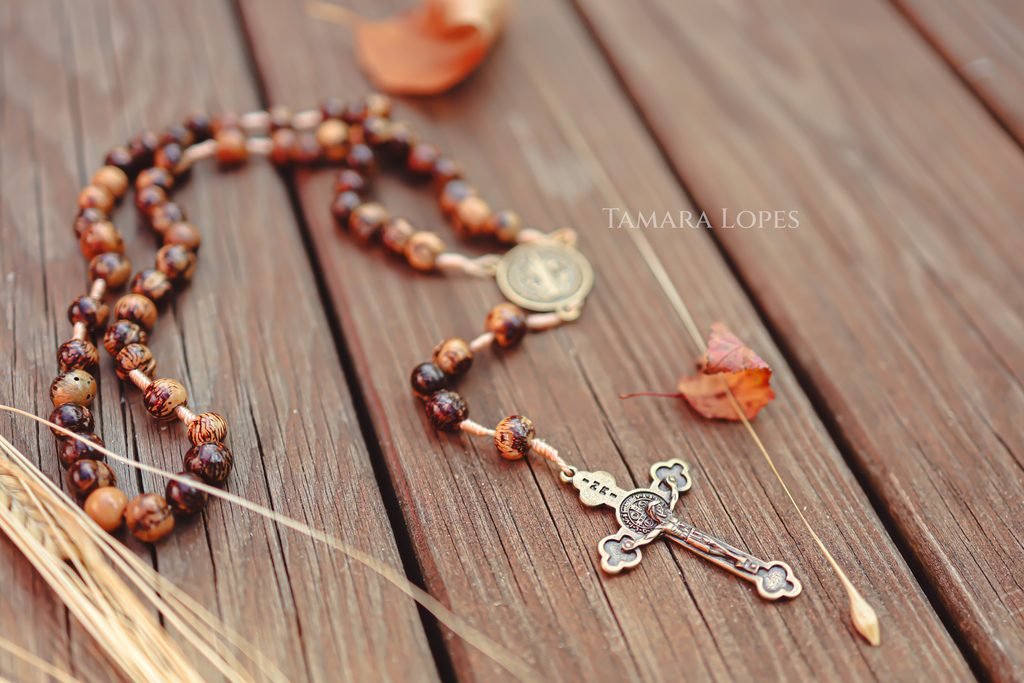
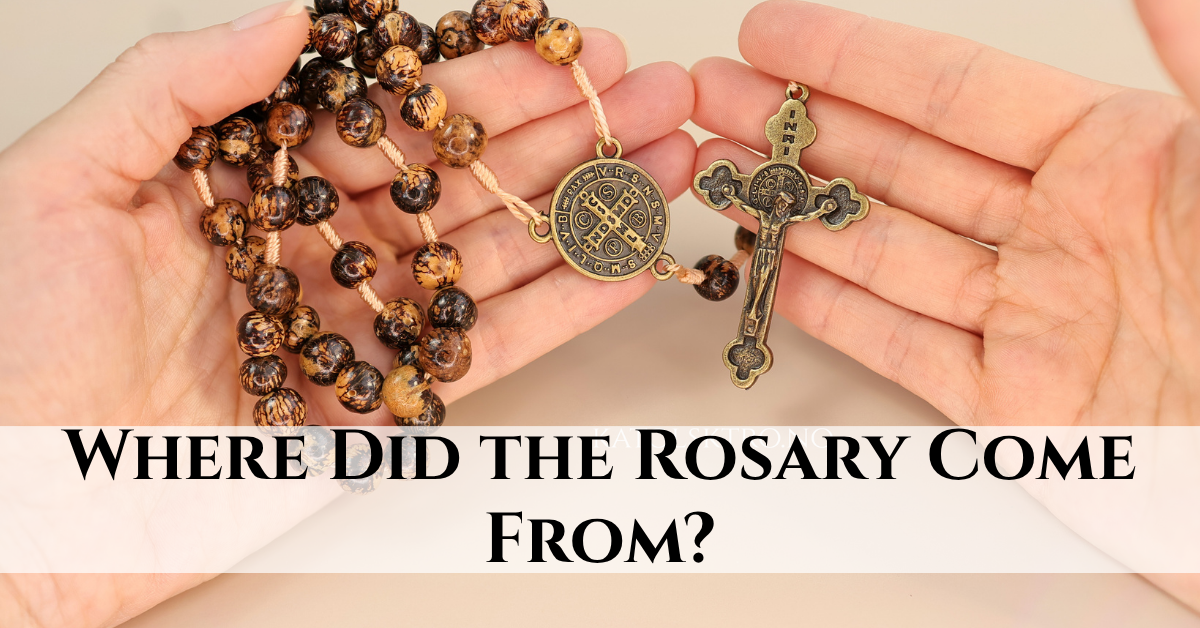
The origin of the rosary is not a single morning and one inventor. It grew. Some parts are very old. The prayer we recognize today is medieval. The official form is later still.
The short answer
Tradition says the Blessed Virgin gave the rosary to St. Dominic in 1208, in Prouille, France.
History shows something slower. Christians were already counting repeated prayers in the third and fourth centuries. The Marian rosary took shape between the twelfth and fifteenth centuries. St. Pius V fixed the classic form in 1569. St. John Paul II added the Luminous Mysteries in 2002.
So: no single inventor, and no single “first rosary.” There is a line.
A timeline
- 3rd–4th centuries: Desert monks in Egypt count prayers with pebbles or knots. They repeat short prayers and psalms. This is not yet the rosary.
- c. 431 and after: After the Council of Ephesus, prayer to Mary grows in the Church.
- 9th–11th centuries: Monks pray all 150 Psalms. Lay people who cannot read begin to replace the Psalter with 150 Our Fathers. Strings of beads are called paternosters. Around 1040, Lady Godiva leaves a jeweled string used for prayer.
- 12th century: Many Hail Marys are already being said. Aibert of Crespin (†1140) was remembered for 150 Hail Marys a day. Groups of fifty Aves, divided into tens, begin to appear.
- 1208 / 1214, by tradition: Our Lady gives the rosary to St. Dominic as a weapon against the Albigensian heresy. Dominicans later become the great preachers of the devotion.
- 13th–14th centuries: Beads, decades, and the name rosarium — “rose garden” — spread. Henry of Kalkar divides 150 Hail Marys into fifteen decades with an Our Father between them.
- 15th century: Dominic of Prussia, a Carthusian, joins each Hail Mary to a moment in the life of Jesus. Blessed Alan de la Roche spreads rosary confraternities and the story of St. Dominic. The prayer now looks like the rosary.
- 1569: St. Pius V, in the bull Consueverunt Romani Pontifices, establishes the traditional Dominican rosary in the Church.
- 1571: After Lepanto, the feast of Our Lady of the Rosary is tied to October.
- 2002: St. John Paul II adds the Luminous Mysteries.
The desert: centuries III and IV
Long before the rosary, Christians in the desert were already counting prayers with their hands.
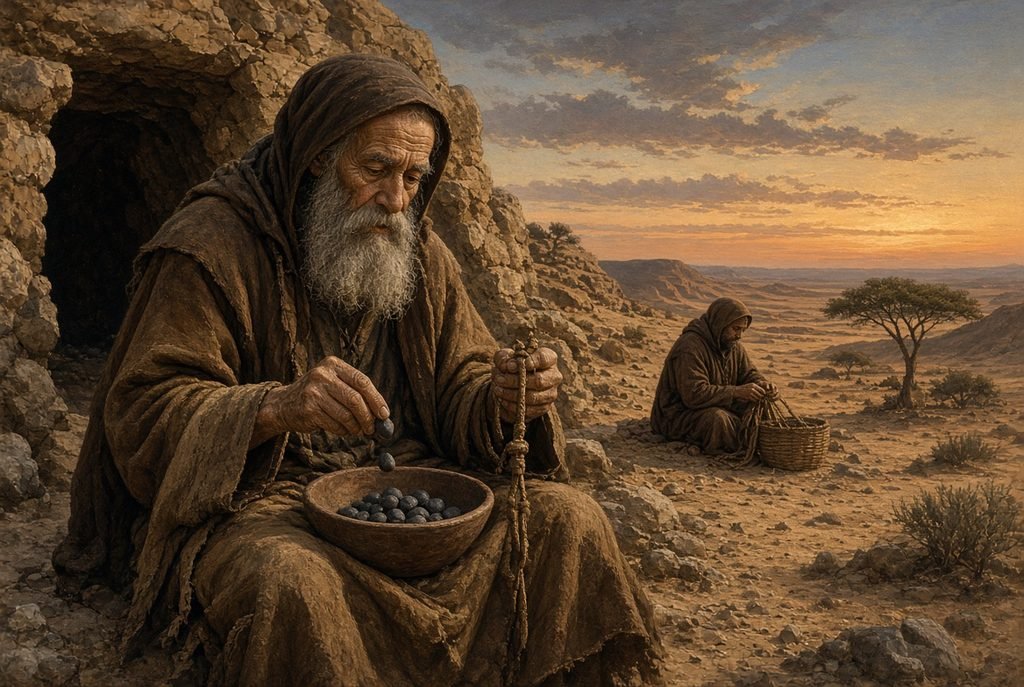
Illustration generated with AI.
In the third and fourth centuries after Christ, men and women left the cities of Egypt, Palestine, and Syria to live St. Paul’s words: “Pray without ceasing” (1 Thess 5:17). Later generations called them the Desert Fathers and Mothers. They were hermits and nuns. They lived in caves and huts, worked with their hands, learned the Psalms by heart, and repeated short prayers all day.
A few names help to picture them. St. Anthony the Great went into the Egyptian desert and became the model of the solitary monk. St. Pachomius gathered monks into communities with a shared rule of work and prayer. St. Macarius taught in the desert of Scetis; one of his prayers was simply, “Lord, as you will and as you know, have mercy.” St. Moses the Ethiopian had been a violent robber before he converted and became a monk. Evagrius was a learned monk who wrote about prayer and temptation. There were women as well, called Ammas, who lived the same life of silence and repeated prayer.
They were not praying the rosary. The Hail Mary as we know it did not yet exist. They used very short prayers: “Lord, have mercy.” Verses from the Psalms. Later, in the Christian East, this became the Jesus Prayer: “Lord Jesus Christ, Son of God, have mercy on me, a sinner.”
Because they prayed so many times a day, they needed a way to keep count.
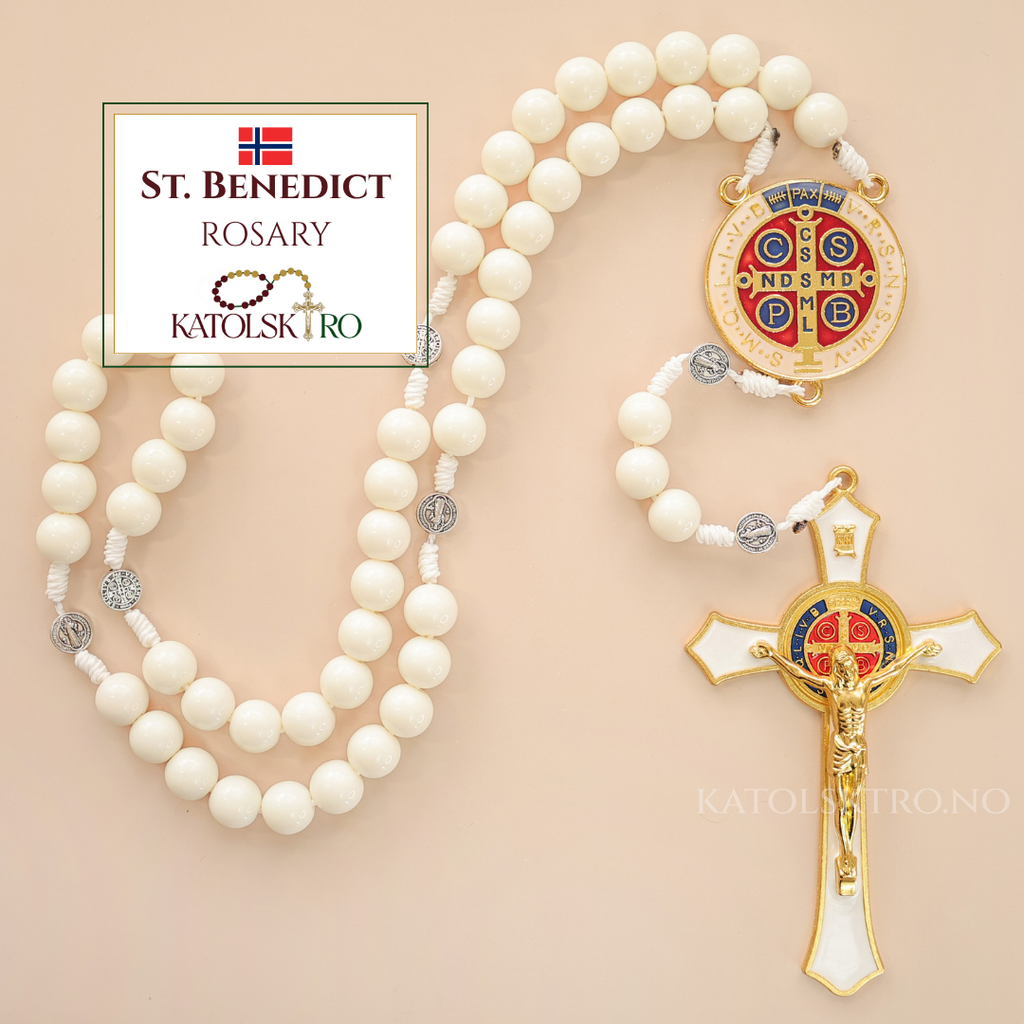
Two old Christian writers tell the same story. Palladius, a bishop who had lived among the Egyptian monks, wrote it in a book called the Lausiac History. The church historian Sozomen repeated it later. The monk in the story is Paul of Pherme, a hermit in the Egyptian desert. He prayed three hundred times a day. He kept three hundred pebbles in his lap and dropped one after each prayer. When the stones were gone, the day’s number was complete. Then he heard of a village woman who prayed seven hundred times. He went to Macarius, unsettled. The answer was simple: if you can do more, do more — but look first at the quality of the prayer.
Other monks were remembered with their own numbers: fifty, a hundred, two hundred. The point was not a contest. It was a rhythm: psalm, pause, short prayer, work, another prayer.
Pebbles spill and get lost. A knotted cord is easier to carry. Later stories say an angel taught St. Anthony to tie each knot in the form of a cross so the devil could not undo the count. That story is legend, not a fourth-century document. The practice itself is old. In the East it became the prayer rope. In the early fifth century, St. John Cassian took this Egyptian way of short, repeated prayer to what is now France. The West received the method.
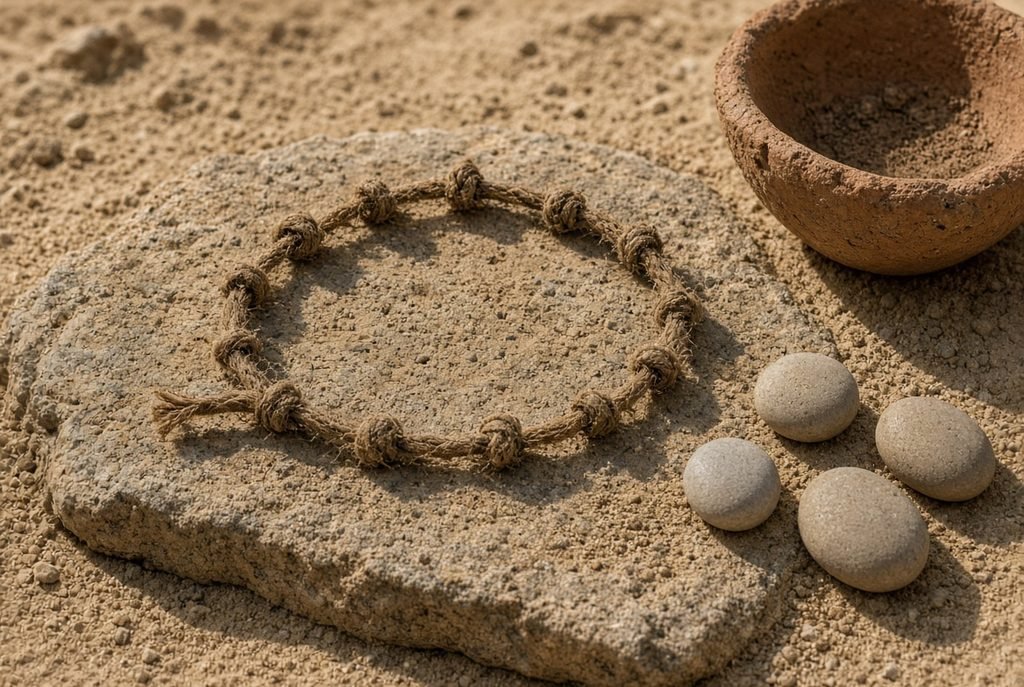
AI-generated reconstruction.
This is the root of the rosary: not Mary’s beads yet, but prayer counted by hand.
How the rosary we know was born
The desert gave the method. The Middle Ages gave it a Marian body.
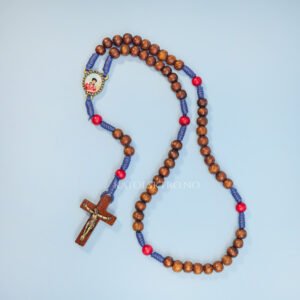
Monks prayed 150 psalms. Most lay people could not read Latin. They prayed 150 Our Fathers instead. That “poor man’s breviary” was counted on knotted cords and later on beads. The beads themselves were called paternosters. In thirteenth-century Paris there were even guilds of bead-makers.
Meanwhile the Hail Mary was growing. First came the angel’s greeting from Luke. Then “blessed is the fruit of thy womb.” The name of Jesus was added. The second half — “Holy Mary, Mother of God, pray for us sinners now and at the hour of our death” — became common later, especially from the fourteenth and fifteenth centuries.
People began to say fifty or 150 Hail Marys. They grouped them in tens. An Our Father stood between the decades, as a psalm-break once stood between psalms.
Then meditation entered. In the early fifteenth century the Carthusian Dominic of Prussia attached to each Hail Mary a clause about the life of Christ. The prayer was no longer only repetition. It became a walking through the Gospel with Mary.
Blessed Alan de la Roche, a Dominican, preached this devotion widely after 1460. He also spread the tradition that Our Lady had given the rosary to St. Dominic more than two centuries earlier. Historians note that Dominic’s own century does not document the story. The Church has still honored the Dominican link, because the Order did more than anyone else to plant the rosary in Christian life.
By then the shape was clear: Creed, Our Father, Hail Marys in decades, Glory Be, and mysteries from the life of Jesus and Mary. St. Pius V confirmed that form in 1569. After the victory at Lepanto in 1571, the rosary was seen not only as private devotion but as a public cry for help.
The Luminous Mysteries, added in 2002, did not invent a new rosary. They filled the public life of Christ between the hidden years and the Passion.
To sum up
The desert invented the counting.
The psalms invented the number 150.
Ordinary Christians invented the substitution of Our Fathers and Hail Marys.
Carthusians helped join the beads to the life of Jesus.
Dominicans preached it and gave it a home in the Church.
St. Pius V settled the classic form.
St. John Paul II opened another set of mysteries.
And above all that, Catholic tradition says the rosary is Mary’s gift: a way to look at her Son.
The first pebble in a monk’s lap was not a rosary. The first full rosary as we pray it today appears when those older habits meet the Hail Mary, the decades, and the mysteries — roughly between 1300 and 1500, and in settled form in 1569.
That is where it came from. Not from nowhere, and not from one hour in 1208 alone, but from centuries of Christians trying to keep the Gospel in their hands.
See also: Is it okay to wear my rosary as a necklace?.